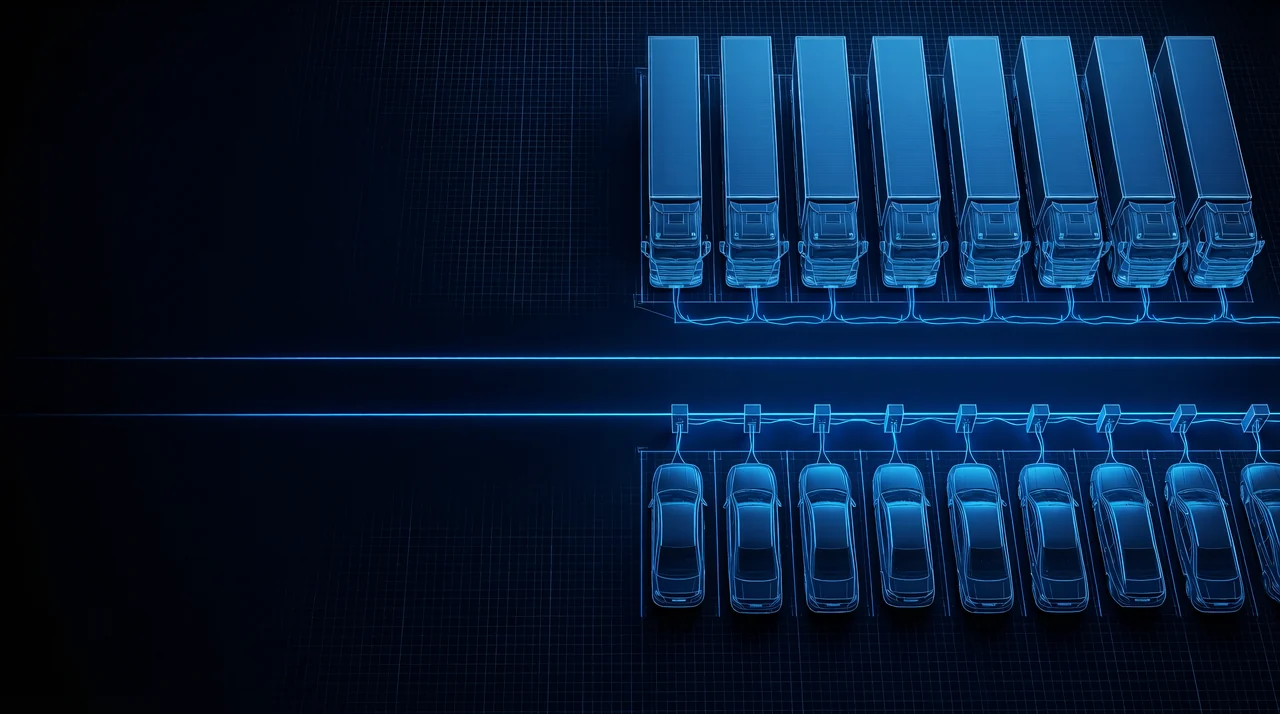
OCPP Gateway
Connect backends and use operational data.
Routing, data exports, workflows and diagnostics extend your existing infrastructure. Connect new applications and prepare for backend changes.
Explore the OCPP Gateway
For operators
Whether you run a depot, a public charging network or a municipal utility: extend your existing infrastructure with the OCPP Gateway or build your charging operations with the Charging Platform. We integrate the software and support your pilot and rollout.
Software for your operations
Your use case determines the building blocks. Your current backend can remain part of the solution.
OCPP Gateway
Routing, data exports, workflows and diagnostics extend your existing infrastructure. Connect new applications and prepare for backend changes.
Explore the OCPP GatewayCharging Platform
The OCPP Server and CPMS modules provide the foundation for charging operations, portals and billing. Plan, module and operating scope are agreed for your project.
Explore the Charging PlatformWhere it hurts
Regardless of size, backend or site model, these are the patterns we hear in almost every conversation with operators.
The contract keeps running, promised features never arrive – and switching is considered too risky internally. So everything stays as it is: the vendor sets the pace, not your operation.
A charge point goes down – but is it the hardware, the backend or the grid? Without your own view into the OCPP traffic, all you can do is file a support ticket. And wait.
Billing under German calibration law (Eichrecht), AFIR requirements, ISO 15118: the bar rises faster than some vendors deliver – and in the end, you are the one held accountable.
With every charge point, the monthly bill grows – often faster than revenue. Pricing models change, and without a credible option to switch, you negotiate from a weak position.
Charging sessions, utilisation, faults: your operational data lives with the vendor instead of with you. Analytics, integrations and any future switch become a matter of negotiation.
More sites, more hardware brands, more edge cases: what worked at one location does not scale by itself – and every new device brings its own firmware quirks.
Operator types
Operations under control
Overnight depot charging or a midday peak: our load management keeps the site below the connection limit, prioritises by departure times and uses PV surplus whenever it is available – from the cloud or locally on site.
How we start
Case studies
WALL-E runs a multi-tenant CPMS platform on our building blocks. DepotCharge attaches billing and high-power chargers to existing backends through the OCPP Gateway. Our case studies show how these projects play out.
Step-by-step backend migration
The OCPP Gateway connects charge points to the existing backend and supports a gradual move to the target system. We validate compatibility, active sessions, switching windows and fallback options against your actual infrastructure in the pilot.
We build charging-infrastructure software for companies including:
Volkswagen · DEKRA · Webasto · Allianz · Audi Denkwerkstatt · WALL-E.works · DepotChargeFAQ
Yes. The OCPP Gateway decouples your charge points from the backend – your current system stays in charge for as long as you want. Switching becomes an option instead of an obligation: you decide if, when and for which sites you move.
For substantial architecture or migration questions, we offer the optional Assessment Workshop at a fixed price of €4,990 plus VAT. It includes 60 minutes of scoping, one customer-specific assessment day via Microsoft Teams, the decision pack within five working days, a prepared customer scenario, 90 days of managed access to a private Enterprise test installation and one follow-up session. After that, the decision is yours with no obligation to implement.
Yes. You choose the operating model: run by us as SaaS, on-premises on your own infrastructure or as an agreed handover to your team. Source-code access, documentation and onboarding are committed in the quotation.
Next step
Start with a demo or an agreed pilot project. For larger architecture questions, the optional Assessment Workshop provides detailed planning.